What Is Data Center Colocation? A Complete Guide
Every business that runs its own servers eventually hits the same wall. The comms room is full, the air conditioning can't keep up, and one power cut takes everything offline. Building a proper data center fixes that, but it takes millions and years. Data center colocation is the middle road: you keep your own hardware, and you put it in a third-party facility built to run around the clock.
What Is Colocation?
If you're asking what is colocation, the short answer is renting space for your servers in someone else's data center. You own the equipment. The provider owns the building and everything that keeps it running.
That means the provider supplies rack space, power, cooling, physical security and network connections. You look after the servers themselves, the operating systems and the applications. Most facilities also sell extra help, often called remote hands, for jobs like swapping a drive or rebooting a box when nobody from your team is on site.
How Do Colocation Services Work?
With colocation services, you first select a facility that fits your needs: location, power, connectivity and price. You sign a contract for space and power, ship or carry in your equipment, and rack it. Then it's connected to the facility's power feeds and to whichever networks you've ordered.
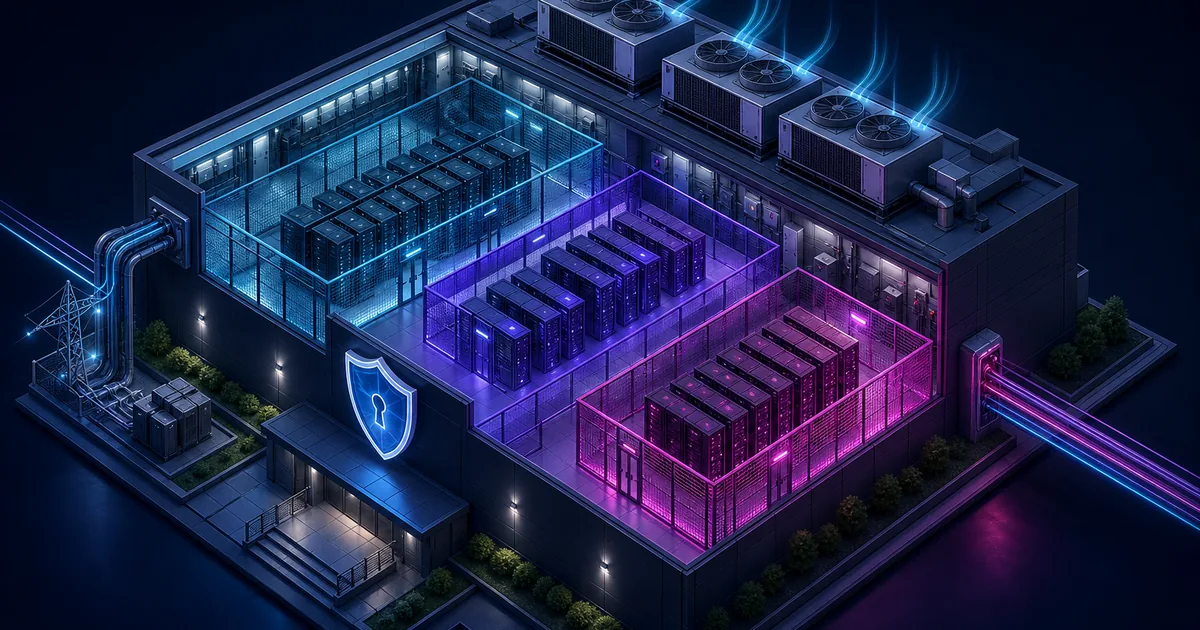
The space comes in different sizes. You can rent a few rack units, a shared quarter or half rack, a full cabinet, a locked cage, or a private suite. Most businesses start small and add space as they grow.
Key Benefits of Data Center Colocation
Cost is the obvious one. You share the facility's power, cooling and security with every other tenant, so you're not paying to build or run them yourself.
Then there's reliability. A decent facility has backup generators, UPS batteries and spare cooling capacity. Your office almost certainly doesn't. Security is tighter too, with controlled entry, cameras and staff on site, often 24 hours a day.
Connectivity is an underrated benefit. Bigger facilities host dozens of carriers, so you can shop around for bandwidth and switch if a supplier lets you down. And growth gets simpler: adding a rack is a contract change, not a building project.
Colocation vs. Data Center: What's the Difference?
The colocation vs data center question confuses people because colocation happens inside a data center. A data center is the building. Colocation is a service sold inside it.
If you run your own data center, you control everything and you're responsible for everything, from the generators to the fire suppression. With colocation, the provider takes on the building and its systems, and you keep control of your own equipment.
How to Choose Colocation Providers
When you compare colocation providers, look at power redundancy, cooling capacity, network options, security, support hours, price, and whether there's space to expand later. Visit if you can. A walk round the data hall tells you a lot that a brochure won't.
Server colocation suits businesses that want to keep control of their hardware without running a building. You can compare providers and facilities in Data Center Planet's colocation directory and find the right fit.