
Why Data Center Planet Beats DataCenterMap for Operators and Buyers
If you work in colocation, interconnection or AI hosting, you have almost certainly used DataCenterMap. It is one of the longest-running public directories of data centers. That history still matters. What has changed is what operators and buyers now need from a directory: a map they can actually use, connectivity context, upcoming industry events, and a listing they can publish without paying to be visible.
Data Center Planet is built for that next step. It is a live global directory of data centers, colocation sites, cloud providers and infrastructure companies, with an interactive map, submarine-cable overlay, events catalogue and free operator listings. Advertising exists for extra placement. The listing itself is not the product you have to buy.
The short answer
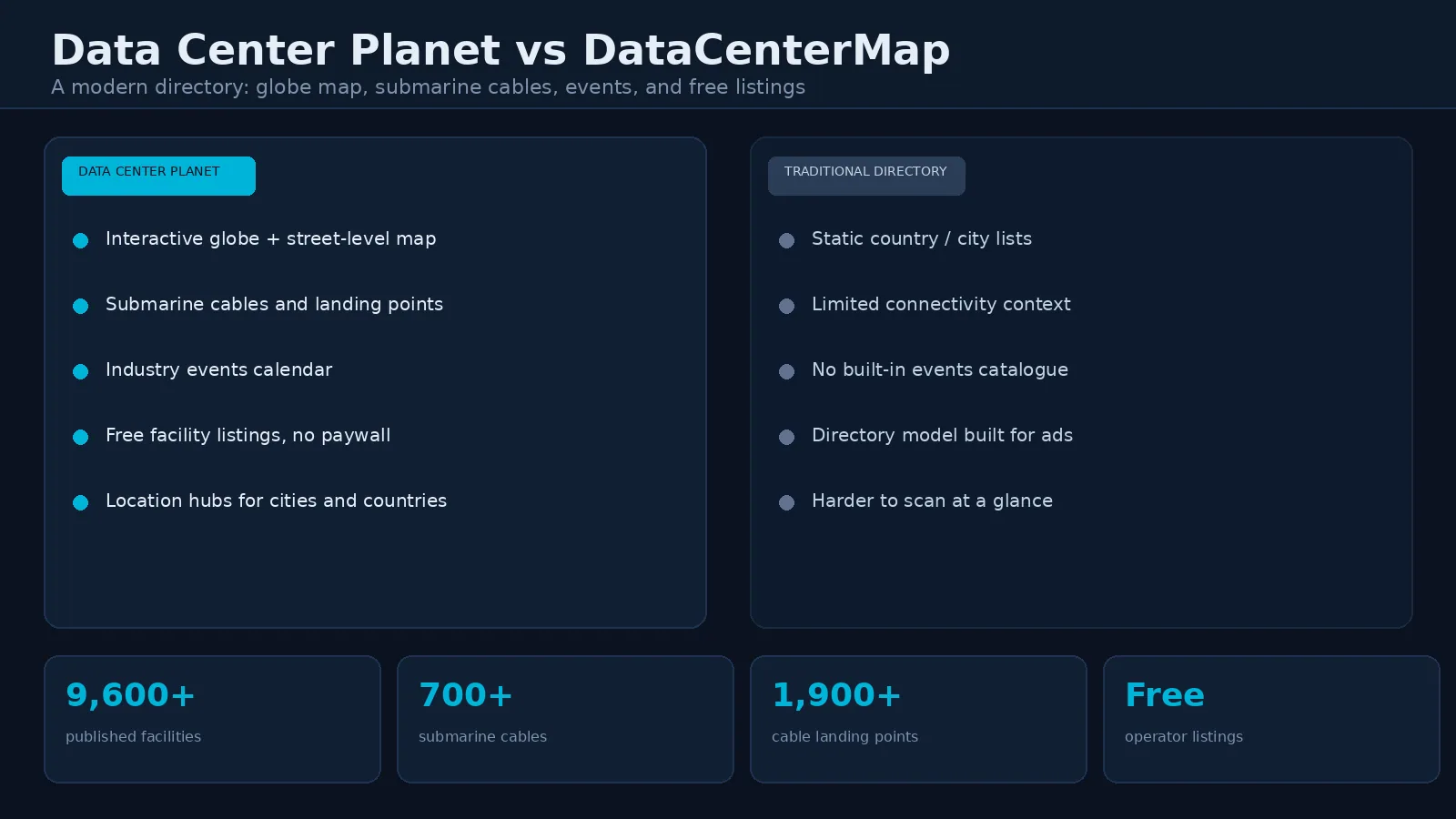
Use Data Center Planet when you want to see the market, not just scroll a city list. The difference is practical:
- Interactive globe and street-level map instead of a static directory tree
- Submarine cables and landing points drawn on the same map as facilities
- A public events calendar for conferences and expos
- Free facility listings with no paywall on the core profile
- A cleaner interface for buyers, operators and AI search engines
Interactive map, not just a list of cities
Most older directories still work like a phone book: pick a country, then a city, then a row of names. That is useful if you already know the metro. It is slow if you are comparing Ashburn with Dallas, or trying to understand how a new AI campus sits against existing capacity.
Data Center Planet starts with the map. The homepage globe clusters facilities geographically. Click a cluster to zoom into a region, then into a city, then into a street-level pin. /?focus=slug can open a specific site so it is not lost inside a dense metro. Country and city hubs at /locations give crawlers and humans the same path: country, then city, then facility.
That is the interface difference in one sentence: Data Center Planet is a map you can drill. DataCenterMap is still, at heart, a catalogue you browse.
Undersea cables on the same canvas
A data center is only as useful as the routes that reach it. Data Center Planet includes more than 700 submarine cables and more than 1,900 landing points. Each cable has a profile with landing points, owners and route context. On the globe, cables can be toggled on so a buyer can see facilities and the wet plant in one view.
That matters for interconnection, content, cloud on-ramps and any operator selling into a landing-station market. A city page that only lists buildings misses the reason many of those buildings exist.
Events data, not just facilities
Site selection and sales calendars now travel together. Data Center Planet publishes a live events catalogue covering industry conferences, expos and regional forums, with filters, calendar views, ICS download and share links. Recent coverage includes DCD Connect MENA in Dubai, Middle East Energy, WETEX, ADIPEC and GITEX GLOBAL.
If you are planning a market visit or a launch, you should not have to leave the directory to find out who is gathering in that city next month.
Free listings, no restrictions on the core profile
Data Center Planet listings are free to create and free to claim. Operators get a public profile, map pin, quote form and the ability to keep specs current. There is no per-lead fee. Advertising is optional and sits on top of the directory as map pins, banners and sponsored content. The FAQ is explicit: all listings remain free and unrestricted regardless of advertising.
That is the commercial line that older directories often blur. A free row with the useful fields locked behind a premium upgrade is not a free listing. On Data Center Planet the basic listing is meant to work: name, location, description, contact, certifications and enquiry path, without paying for the right to exist in the index.
To list a site, create an account and add the facility from the dashboard. If the site is already in the directory from PeeringDB or OpenStreetMap, claim it with a business email. Basic listings are reviewed and typically published within one business day.
A better interface for people and for search
The product surface is darker, faster and built around three jobs: find a site, understand its connectivity, and contact the operator. News, locations, events and listings share the same navigation. Listing pages include related facilities in the same city, so users and crawlers can move between neighbouring sites without bouncing back to a search box.
That structure is also what makes the site usable for Google and for AI answers. Every facility, city hub, cable and article has a stable URL, a canonical tag, Open Graph metadata and structured data. The news pages emit NewsArticle JSON-LD. Location hubs are crawlable HTML, not a JavaScript-only globe. IndexNow pings search engines when pages change.
As of August 2026 the live directory holds 9,600+ published facilities, sourced from PeeringDB, OpenStreetMap, operator submissions and manual review. Coverage is strongest in North America, Europe and Asia-Pacific, with ongoing expansion in LATAM, the Middle East and Africa.
Data Center Planet vs DataCenterMap
| Need | Data Center Planet | Typical older directory |
|---|---|---|
| Browse facilities | Globe, street map, city hubs and search | Country / city lists |
| Connectivity | Submarine cables and landing points on the map | Limited or separate from the listing |
| Industry calendar | Built-in events catalogue | Usually absent |
| Operator listing | Free core profile, no per-lead fee | Often freemium / paid visibility |
| Interface | Map-first, dark UI, quote form on every profile | Catalogue-first, ad-heavy pages |
| Discoverability | Canonical URLs, JSON-LD, location hubs, IndexNow | Varies; many pages are thin city lists |
Who should switch
Buyers comparing colocation or interconnection should start on the Data Center Planet map, then open the city hub and the cable layer before requesting quotes. Operators who want a public profile without buying a package should list or claim their facility. Event teams and market-entry leads can use the events page alongside the same geography.
DataCenterMap remains a familiar reference. If your workflow is “type a city, copy a list”, it still does that job. If your workflow is “show me the market, the cables, the events and a listing I do not have to rent”, Data Center Planet is the better directory.
FAQ
Is Data Center Planet a free alternative to DataCenterMap?
Yes for the core jobs. Browsing, map search, news, events and a basic operator listing are free. Paid products are advertising and featured placement, not access to the directory.
Does Data Center Planet show submarine cables?
Yes. The platform includes 700+ submarine cables and 1,900+ landing points, with cable profiles and a toggle on the interactive globe.
Can I list a data center for free?
Yes. Create an account, add or claim the facility, and submit it for review. There is no charge to publish a standard listing and no fee per enquiry.
Does Data Center Planet include industry events?
Yes. The public events catalogue covers conferences and expos, including regional Middle East fixtures such as DCD Connect MENA, Middle East Energy, WETEX, ADIPEC and GITEX.