
Cur8.art Launches Conservation Quality Index to Score How Well Rooms Protect Specific Collections
Cur8.art has introduced the Conservation Quality Index (CQI), a single 0–100 score that measures how well a space actually protects the specific objects inside it. The company has filed to trademark the metric, a practical step in how museums and galleries track environmental risk.
Most existing guidance stays high-level. ASHRAE climate classes, the Image Permanence Institute’s Preservation Index, and the Canadian Conservation Institute’s agents of deterioration each give useful frames, but they tend to treat the room as the unit of analysis. A space held at 21 °C and 50 % relative humidity can look acceptable on paper while still stressing certain materials more than others. CQI starts with the collection itself.
How the score is built
Every five minutes the platform pulls live sensor data and runs a five-step calculation. First it builds a material profile for the zone — for example 60 % oil paintings, 25 % gilded wood frames, 15 % works on paper — drawing on standards such as BS EN 16893, PAS 198 and ASHRAE Chapter 24. Those proportions define a composite safe envelope rather than a generic one.
Seven parameters are then scored independently from 0 to 100 according to how far they sit from the optimal range for that mix of materials:
- Relative humidity level — 25 %
- Relative humidity stability — 15 %
- Temperature — 20 %
- Temperature stability — 10 %
- Light / lux — 15 %
- UV — 10 %
- Biological risk — 5 %
The weighted sub-scores are combined and smoothed into a 30-day rolling average. Instantaneous values still feed the alert system, so staff see both the long-term picture and the moment something drifts. Institutions can adjust the weights if their risk priorities differ.

How to read the number
Interpretation is straightforward. Scores of 95–100 sit in the museum-grade optimal band, roughly ASHRAE AA, and support international loans. 85–94 is excellent and usually fine for national loans. Below 70 the system flags the need for intervention; below 50 the risk of measurable degradation rises quickly.

Same room, different scores
The difference becomes clear in practice. One gallery holding mostly Old Masters at a steady 21 °C / 50 % RH with modest light levels scored 91 — strong enough for national loans, with relative humidity the weakest sub-score. A photography space held cooler and drier with tighter light control reached 96. A mixed-media gallery with larger temperature and humidity swings, higher light levels and elevated mould risk landed at 57, pointing conservators and facilities teams toward specific fixes: stabilise the HVAC, reduce lux, and move the most vulnerable paper works.
Because the metric is object-aware, the same environmental readings produce different scores depending on what is stored or displayed. That is the practical advance.
Built for day-to-day operations
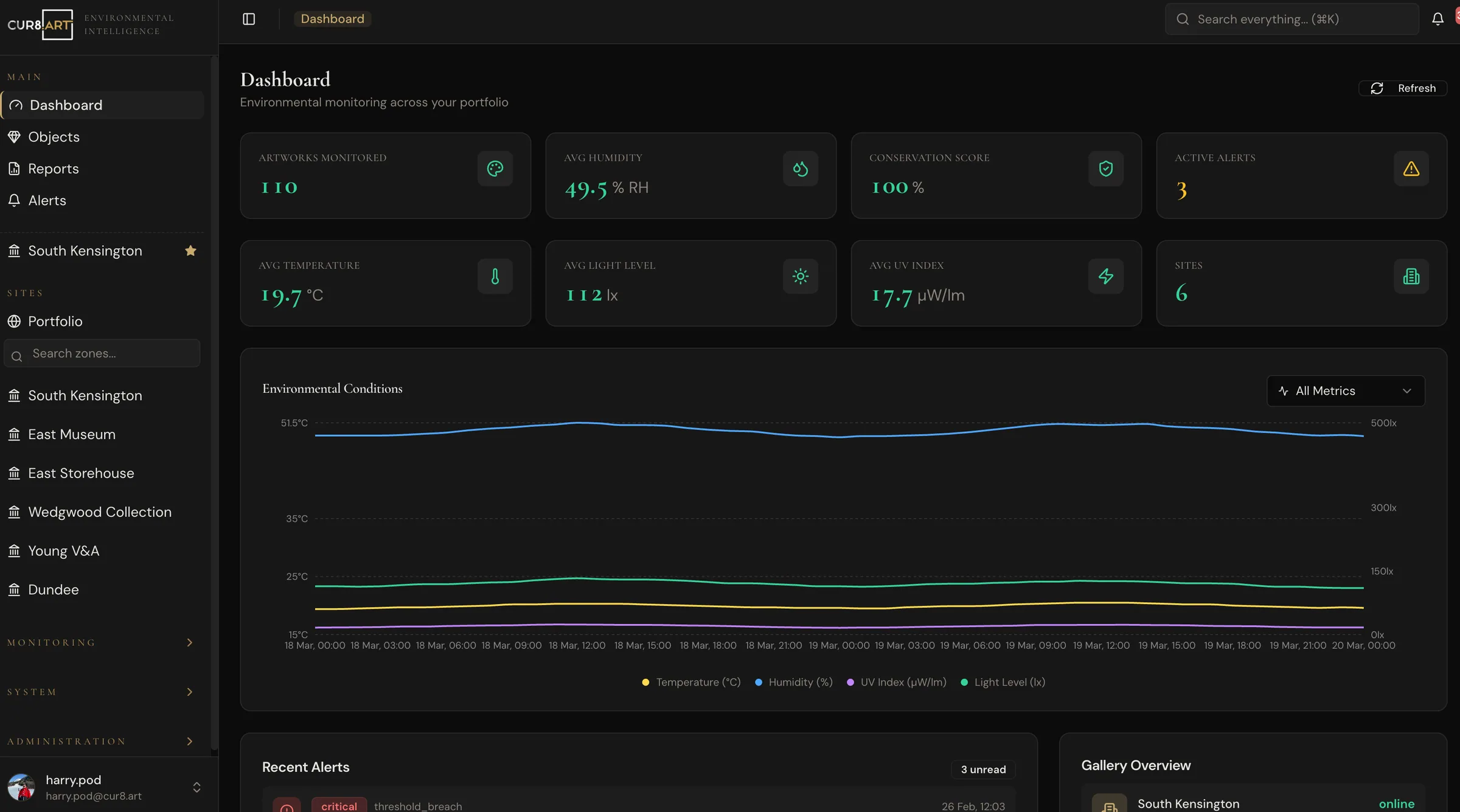
CQI runs inside the broader Cur8.art platform, which combines environmental monitoring, asset tracking and preventive alerts. Computation happens on the edge gateway so the score updates without constant cloud round-trips. Dashboards show institution-wide numbers, zone breakdowns, trend lines with event annotations, and period reports useful for loan condition files or insurance reviews. The system already talks to existing building-management systems and respects role-based access for conservators and facilities staff.
The company positions the platform for institutions of any size, claiming 99.9 % uptime and continuous monitoring. Compliance language references ICOM and ASHRAE standards, and the audit trail is designed to satisfy both insurance and regulatory needs.
Why the trademark matters
Trademark applications are routine, yet they signal intent. By securing the Conservation Quality Index name, Cur8.art is claiming a specific way of turning multi-parameter sensor data into a single, comparable number that conservation and operations teams can both use. Shared language reduces the usual gap between “the room is fine according to the set points” and “this particular collection is still at risk.” Full details appear on the company’s site at cur8.art/news/introducing-cqi-conservation-quality-index.
For data centre and infrastructure readers the interest is twofold. First, the architecture — edge processing of dense environmental streams, reliable uptime, integration with legacy BMS — mirrors challenges familiar in critical facilities. Second, cultural institutions are becoming more sophisticated consumers of monitoring technology. A clear, material-specific score makes the business case for better sensors, tighter controls and continuous oversight easier to defend.
CQI will not replace specialist judgment or detailed condition reports. What it does offer is a continuous, transparent benchmark that sits between the sensor network and the decision-makers. In a sector where small environmental drifts accumulate into irreversible damage, that kind of shared metric is overdue.
Explore more infrastructure and monitoring coverage on Data Center Planet.