Beyond Standard DCIM: Why AI Data Centers Need Deeper BMS and PMS Integration
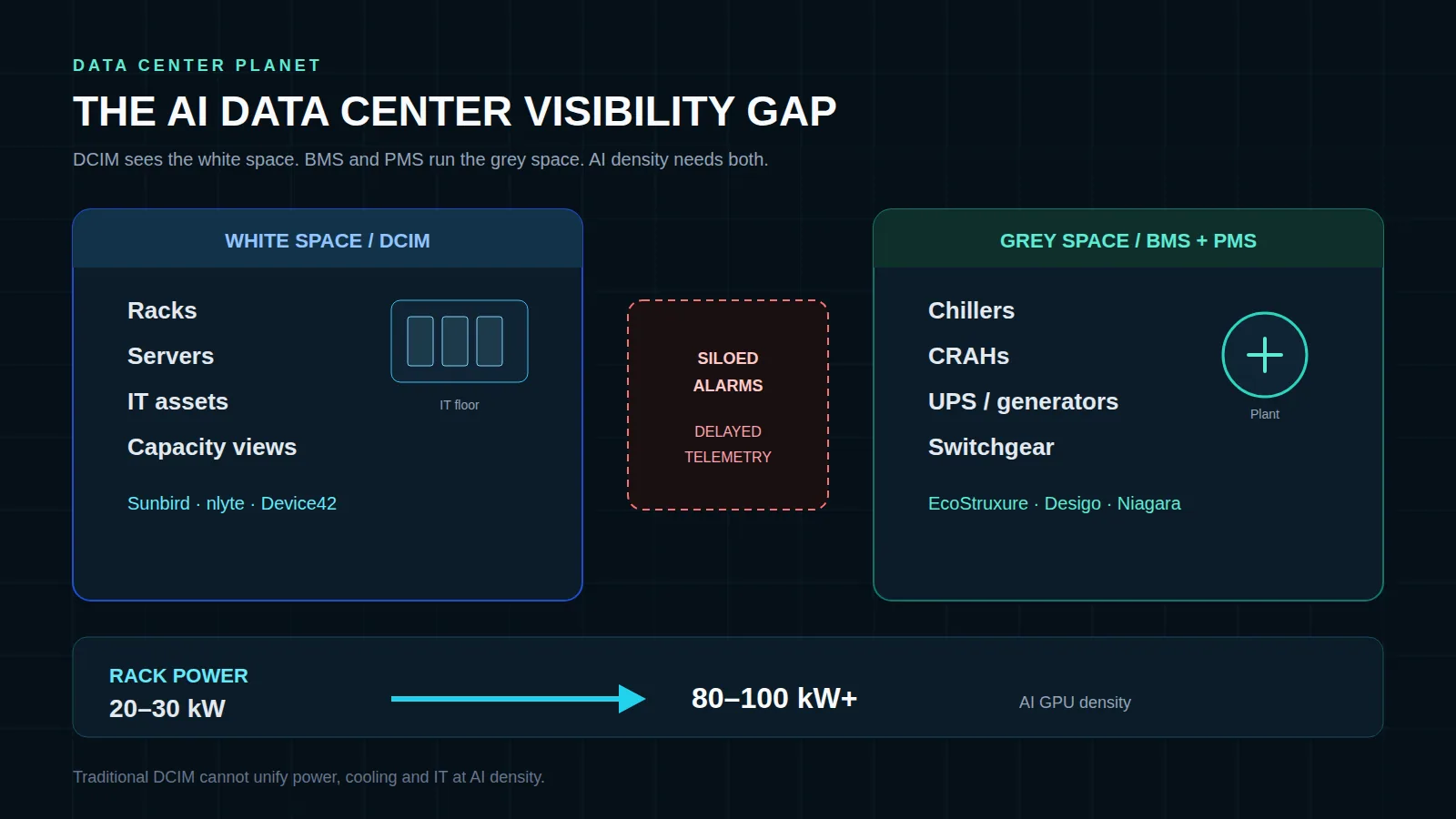
As AI factories and high-density GPU clusters push rack power from 20–30 kW toward 80–100 kW and beyond, traditional Data Center Infrastructure Management (DCIM) platforms are reaching their limits. Tools such as Sunbird (dcTrack and Power IQ), nlyte, and Device42 excel at asset tracking, capacity visualization, discovery, and power monitoring. However, operators are increasingly finding that these systems alone cannot deliver the real-time, cross-domain visibility required when power, cooling, and IT loads interact at AI scale.
The core challenge is fragmentation. DCIM typically focuses on the “white space” — racks, servers, and IT assets. Building Management Systems (BMS) and Power Management Systems (PMS/EPMS) control the “grey space” — chillers, CRAHs, UPS systems, generators, switchgear, and environmental controls. In multi-vendor or legacy environments these layers rarely communicate seamlessly. Alarms remain siloed, power telemetry is often delayed or incomplete, and capacity planning stays overly conservative because operators lack a unified, low-latency view of actual headroom under variable AI workloads.
The security constraint: data out of the DMZ
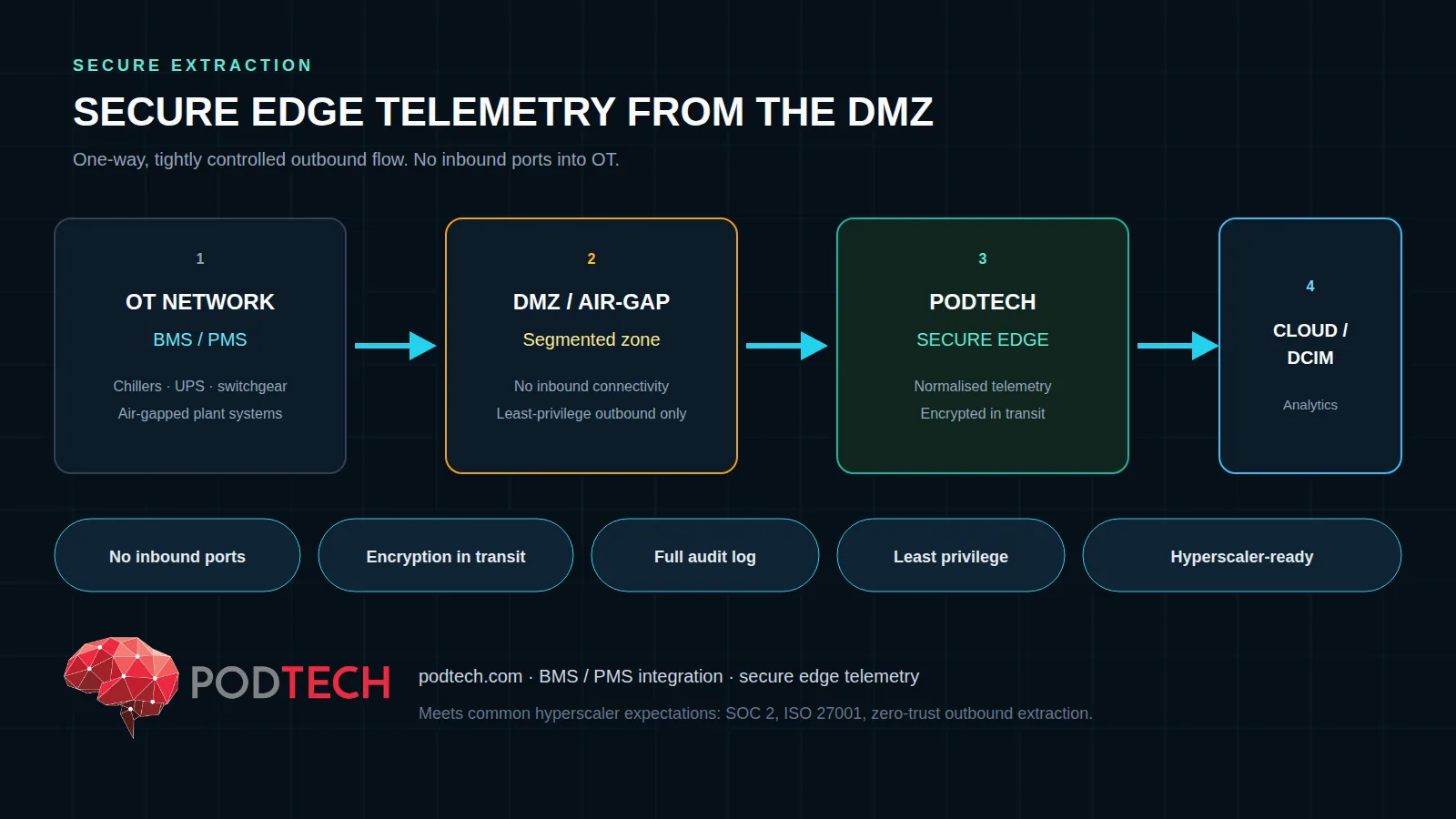
A further complication for hyperscalers and high-security facilities is the need to extract operational data from the DMZ (or other segmented secure zones) without compromising the air-gap or increasing the attack surface. Hyperscale operators typically enforce strict standards: no inbound connectivity to OT networks, one-way or tightly controlled outbound data flows, encryption in transit, full audit logging, least-privilege access, and architectures that align with zero-trust principles and common compliance frameworks (SOC 2, ISO 27001, and internal hyperscaler security baselines). Any telemetry solution that requires opening ports into the DMZ or exposing BMS/PMS systems directly to the public internet is usually rejected.
Deep BMS/PMS integration plus secure edge telemetry
The approach gaining traction is deep BMS/PMS integration combined with secure edge telemetry. Specialists such as PODTECH, which focuses on bridging BMS and PMS platforms including Schneider EcoStruxure, Siemens Desigo, Tridium Niagara Framework, Delta InfraSuite and Johnson Controls Metasys, address both the integration and security requirements. Their secure edge telemetry approach enables controlled, one-way or highly restricted data extraction from the DMZ and other segmented environments, delivering normalized real-time telemetry to cloud or central analytics platforms without exposing critical infrastructure. This model meets the security expectations commonly required by hyperscalers. PODTECH also provides DCIM consultancy and master systems integration for multi-vendor sites.
Key benefits
- Near real-time power and status visibility across UPS, generators and distribution
- Correlated power-cooling-IT insights that unlock stranded capacity
- Faster root-cause analysis during AI load spikes
- Higher-quality data flowing into platforms such as Sunbird, nlyte or Device42
- Secure data extraction from the DMZ that satisfies hyperscaler security standards
- Reduced risk when deploying high-density pods or consolidating multi-vendor sites
For AI operators the practical payoff is significant. Accurate, securely extracted telemetry supports tighter safety margins without over-provisioning, enables predictive maintenance on critical power assets, and shortens the validation cycle for new high-density deployments. In hyperscale and colocation environments it also simplifies tenant metering and compliance reporting under tightening energy and sustainability requirements.
As AI demand continues to accelerate, the most resilient facilities will treat DCIM, BMS and PMS not as separate tools but as an integrated operational layer protected by modern secure extraction methods. Operators evaluating or expanding Sunbird, nlyte, Device42 or similar platforms should place both multi-vendor integration capability and DMZ-compliant secure telemetry high on their selection criteria.
Explore global data center listings, power and infrastructure providers, and specialist integration services on Data Center Planet.
podtech.com · BMS / PMS integration · Secure edge telemetry · Contact PODTECH